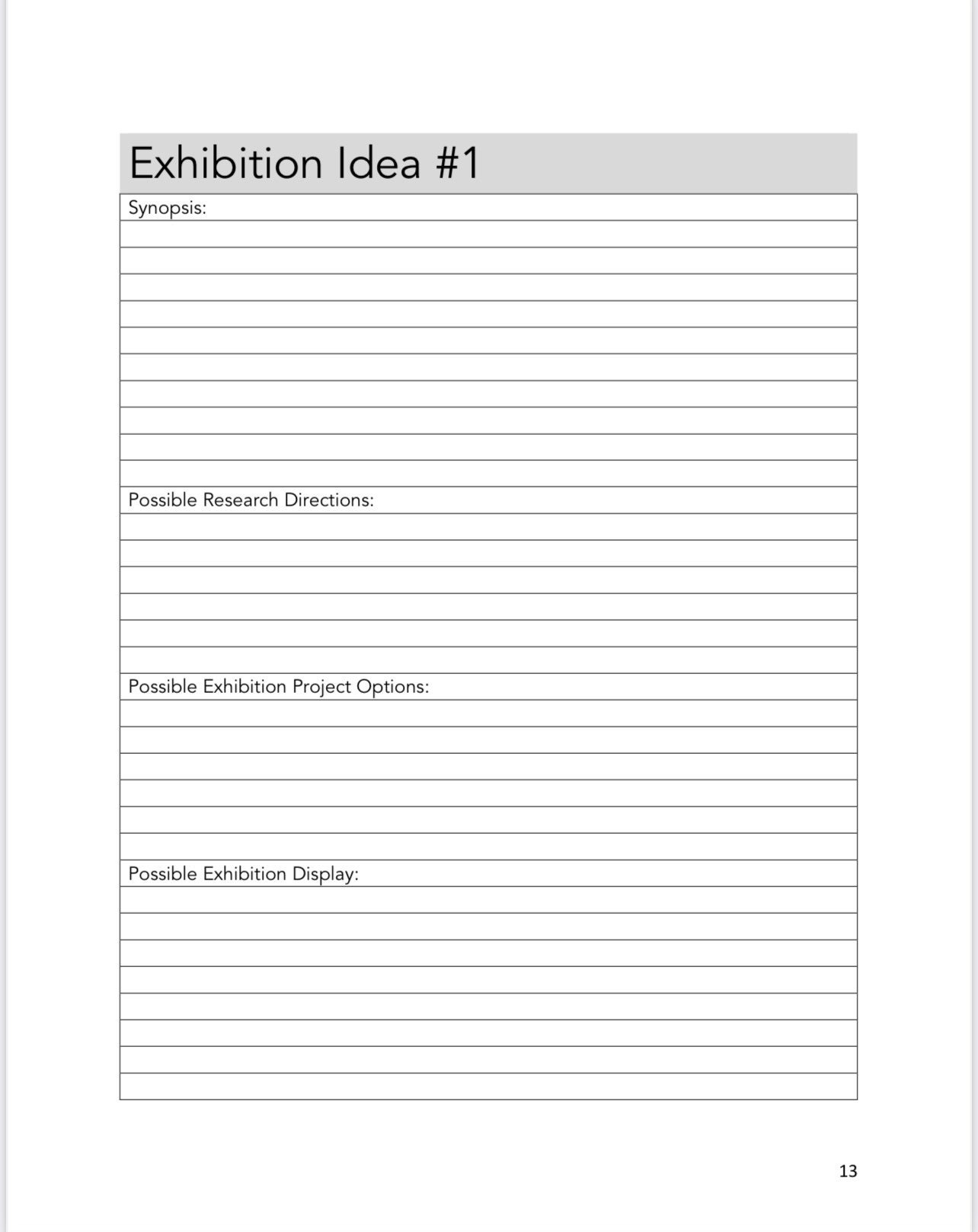
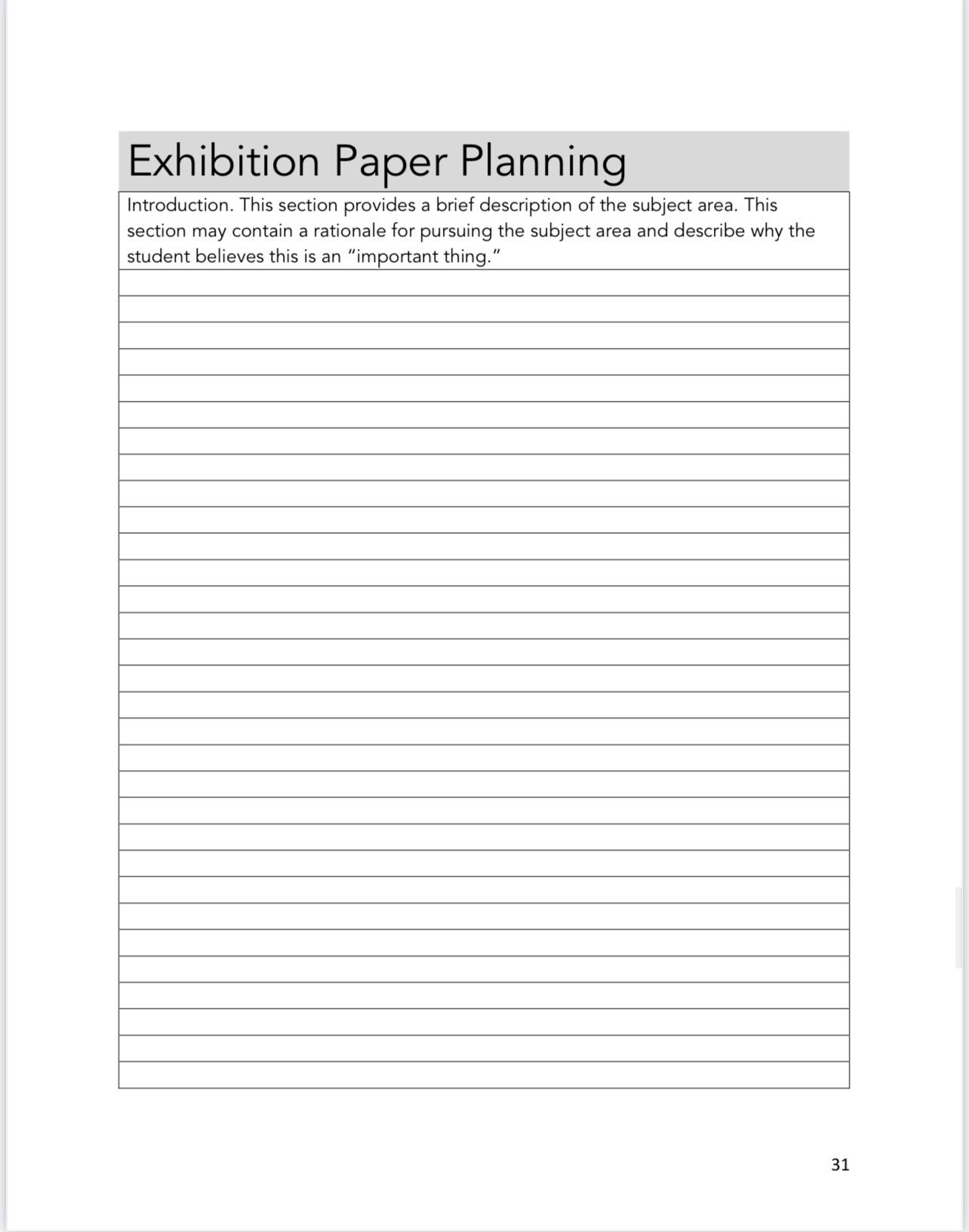
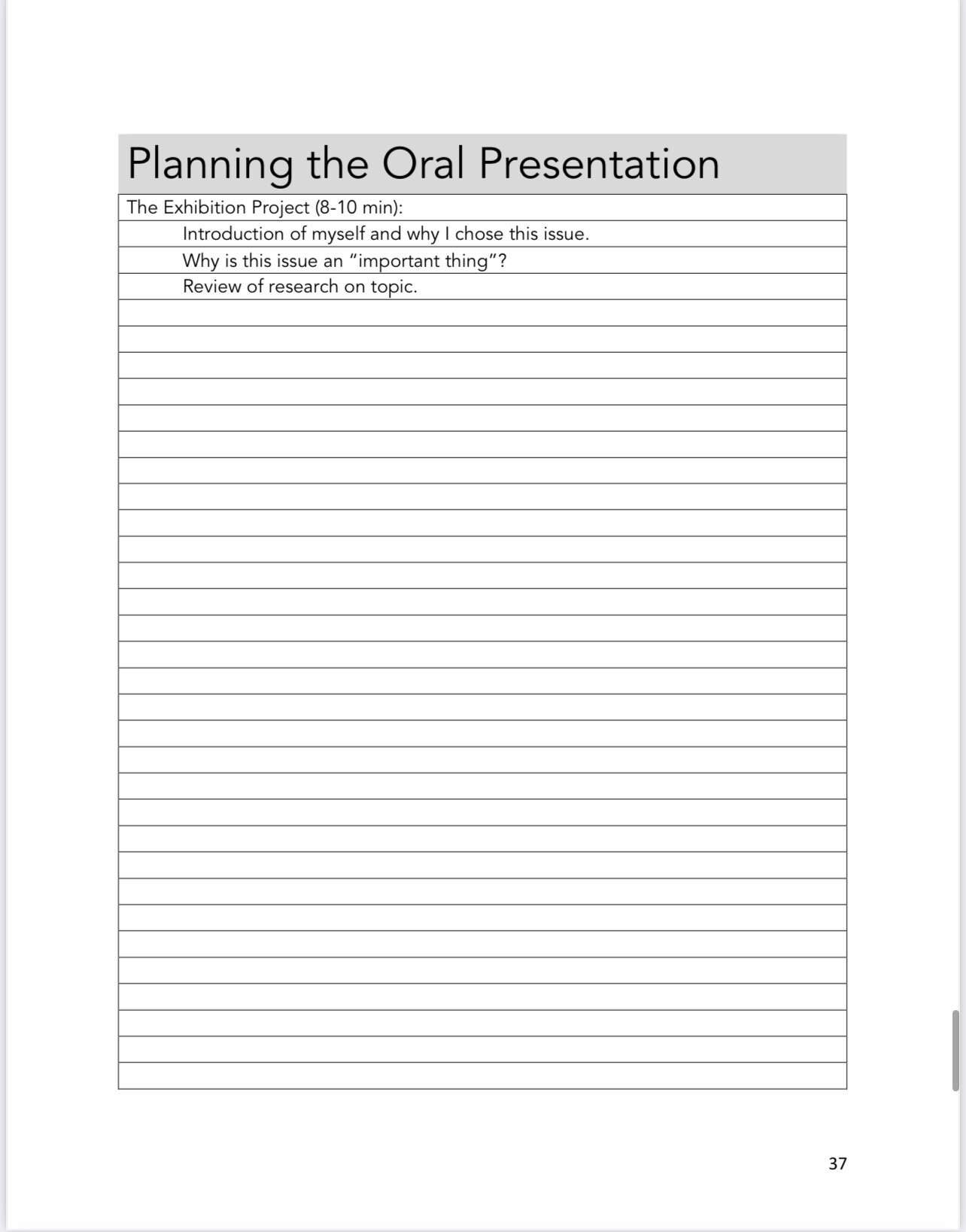
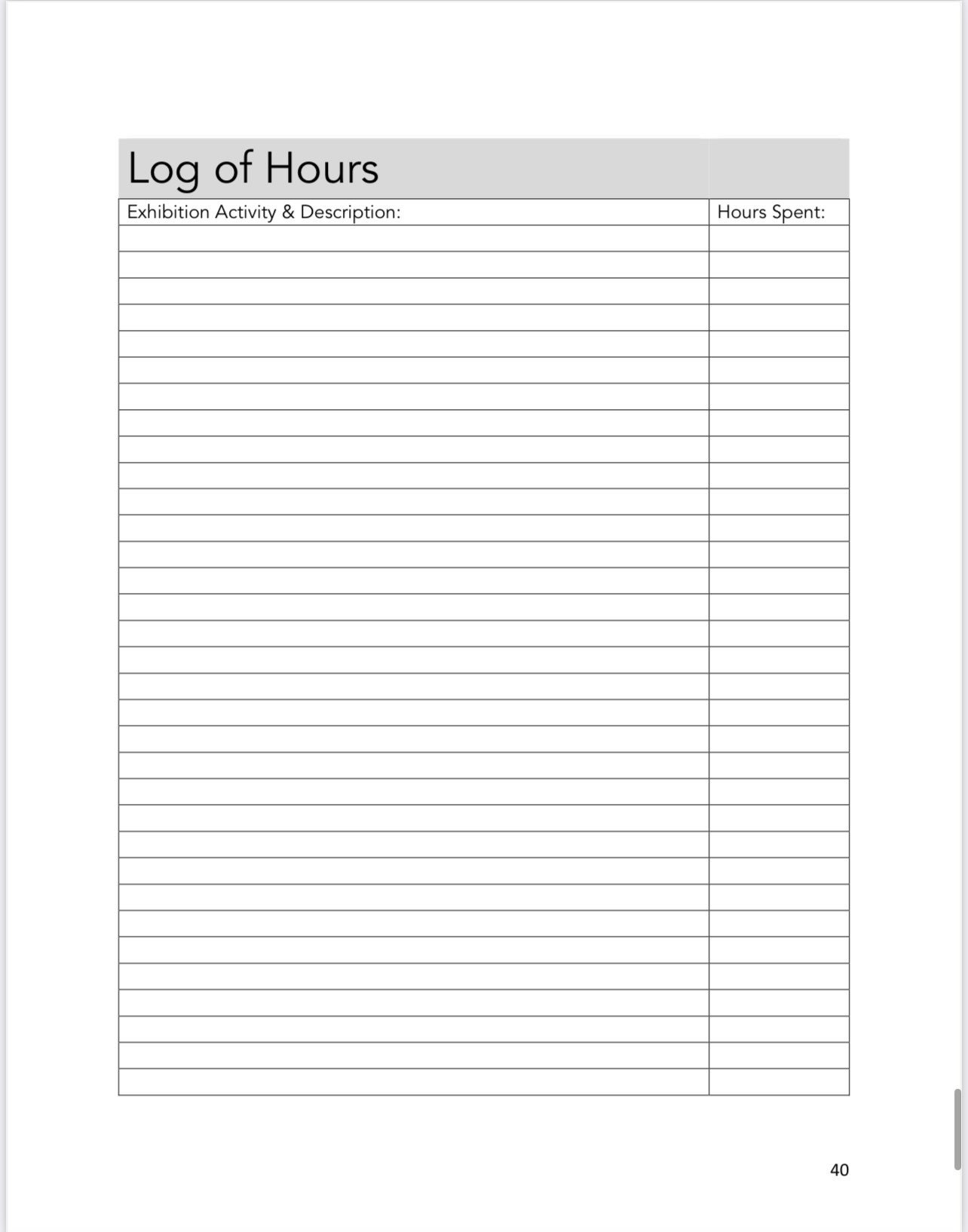
The Exhibition Journal is a comprehensive tool to help a student move through their senior exhibition.
What is the Senior Exhibition?
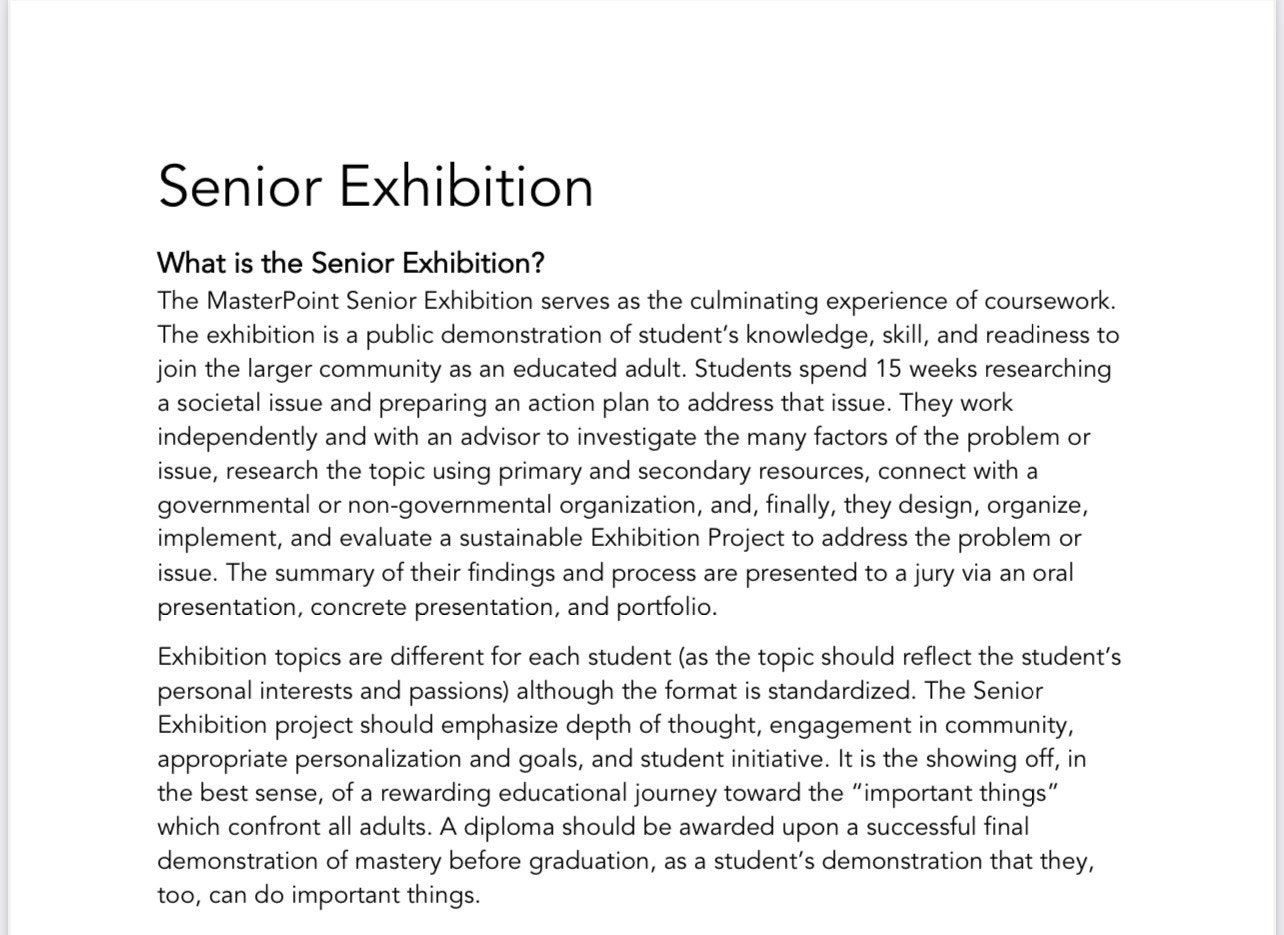
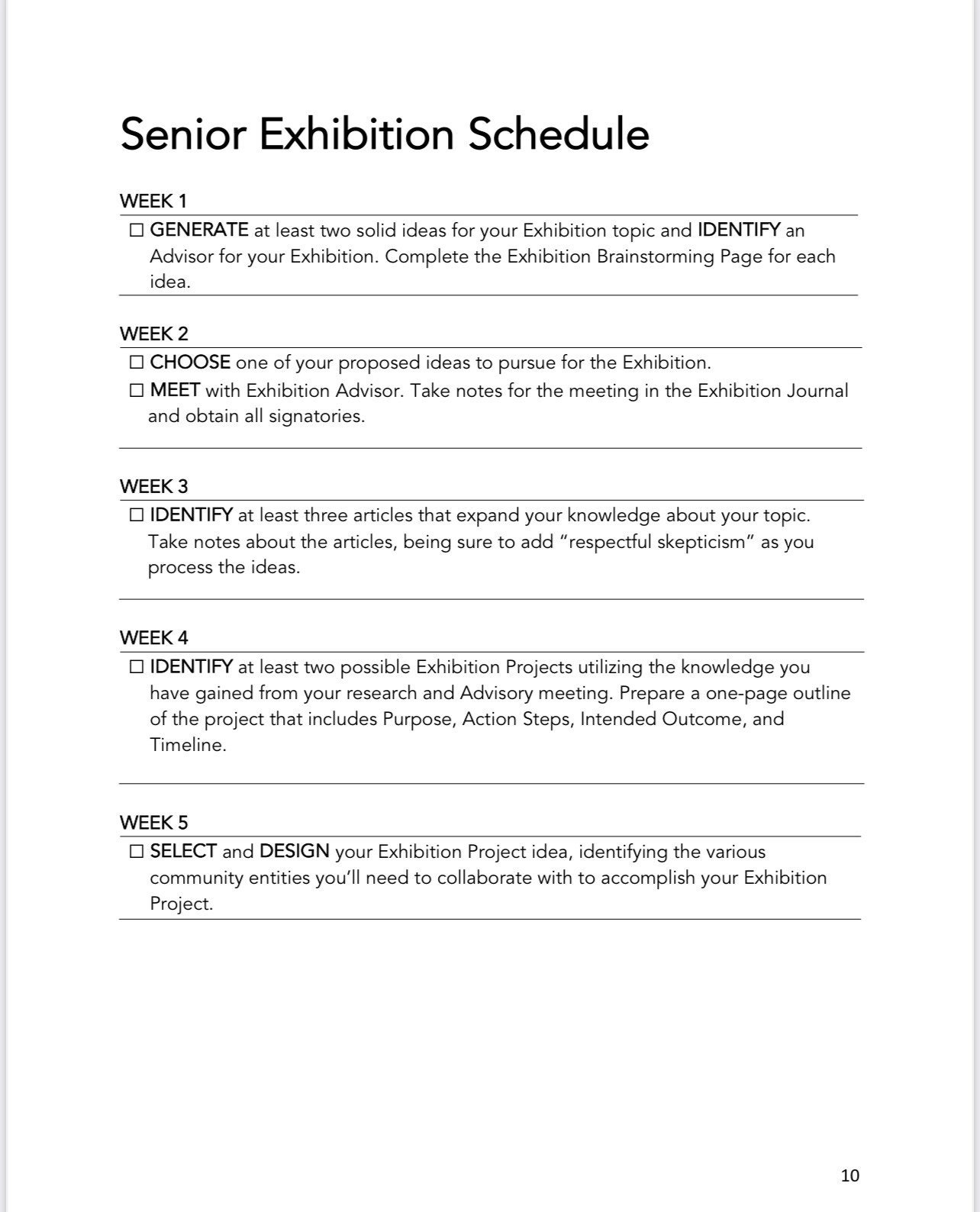
The exhibition is a public demonstration of student’s knowledge, skill, and readiness to join the larger community as an educated adult. Students spend 15 weeks researching a societal issue and preparing an action plan to address that issue. They work independently and with an advisor to investigate the many factors of the problem or issue, research the topic using primary and secondary resources, connect with a governmental or non-governmental organization, and, finally, they design, organize, implement, and evaluate a sustainable Exhibition Project to address the problem or issue. The summary of their findings and process are presented to a jury via an oral presentation, concrete presentation, and portfolio.
Exhibition topics are different for each student (as the topic should reflect the student’s personal interests and passions) although the format is standardized. The Senior Exhibition project should emphasize depth of thought, engagement in community, appropriate personalization and goals, and student initiative. It is the showing off, in the best sense, of a rewarding educational journey toward the “important things” which confront all adults. A diploma should be awarded upon a successful final demonstration of mastery before graduation, as a student’s demonstration that they, too, can do important things.
There are four judging elements in the MasterPoint Senior Exhibition:
Exhibition Project: The Exhibition Project should impact the larger community in some way. This project helps students realize their agency and get their hands dirty to do something, not just be a spectator watching someone else perform!
Exhibition Display: This segment of the project should further illuminate the topic or Exhibition process for the student. It might be a video, poetry, sculpture, painting, etc. Students are presenting their topic and experience in a tactile manner.
Portfolio: The portfolio should contain the student’s written Exhibition Paper and Exhibition Journal.
Exhibition Paper: Students develop an original thesis and sophisticated argument illustrated within in a 10-page to 15-page paper that includes
Introduction, Demonstrated Issue, Relevant Research on Issue, Exhibition Project Description, Assessment of Impact, and Conclusion. Papers should utilize correct MLA formatting, including citations.
Exhibition Journal (this book): Students should prepare a research journal with a minimum of 15 entries detailing their research process, “respectful skepticism,” and thoughtful analysis of the topic/issue. The journal should include the planning notes and response from the Exhibition Project, notes from Advisory meetings and Governmental/Non-Governmental Organization Meeting Notes, as well as a Log of hours spent on designing, planning, implementing, and evaluating their Exhibition.
Oral Presentation: The presentation should include the reason why the student was drawn to this topic, a persuasive exposition of why this topic is an “important thing,” the relevant research on the topic, how the student determined their Exhibition Project, the steps taken to implement the Exhibition Project, and the assessment of the project, as well as proposed next steps that could be taken to make a difference regarding this topic. Students should use a multi-media presentation (Exhibition Display) in conjunction with their oral presentation. Following the presentation – which should last 20-30 minutes — the student answers questions about their project from the Exhibition Jurors.
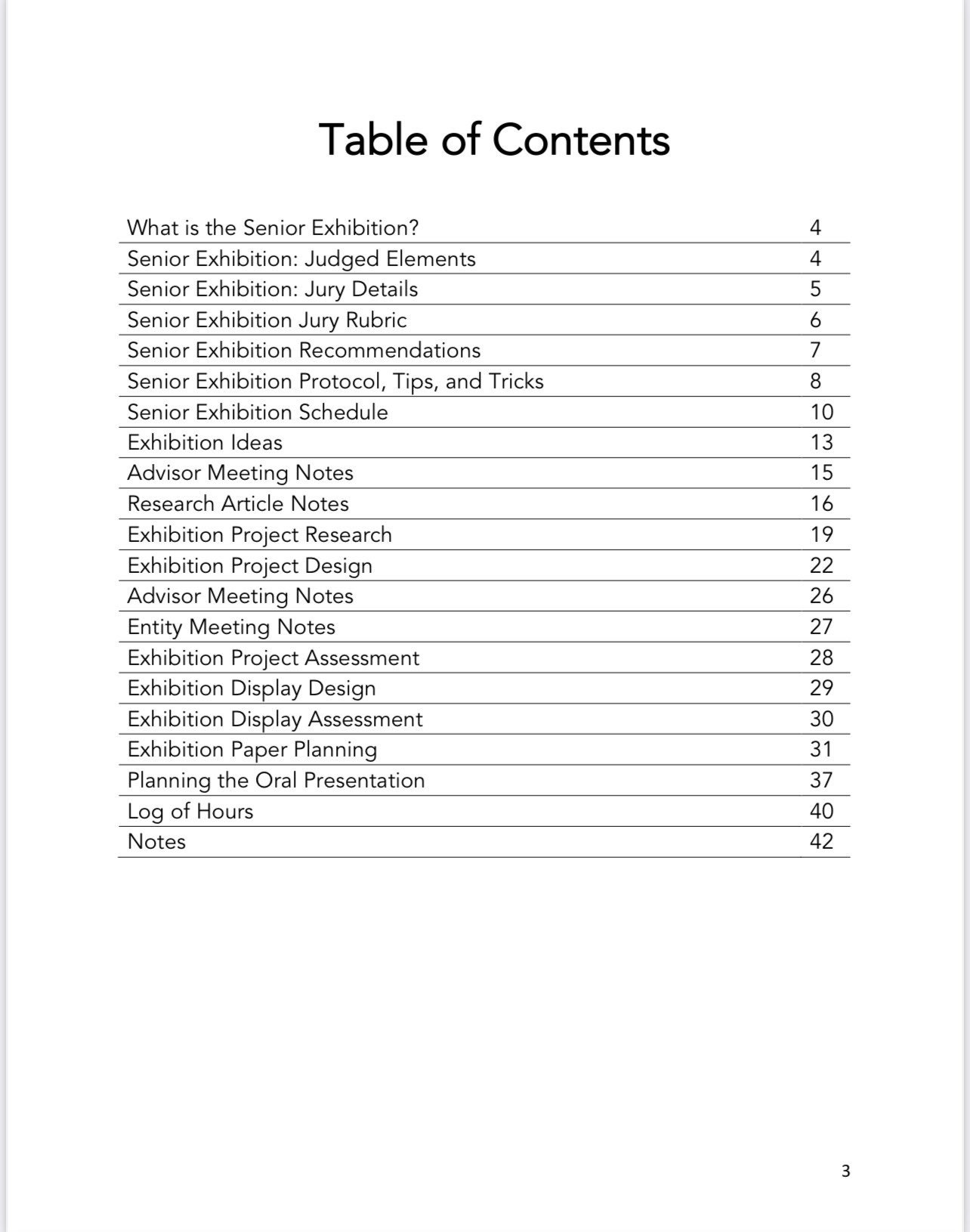
This Exhibition Journal will guide students through the entire process. It provides guidance for each element, as well as a judging rubric for the jurors.
Frequently Asked Questions
Who wrote the guide?
JJ Veale is a homeschooling mom of four children and the wife of Isaiah. Her earliest ambitions were to be a mom and a writer. JJ received a Journalism degree from the University of Arizona, a masters degree in Higher Education and Student Affairs, and completed all but dissertation for an EdD degree in History of Education from Indiana University. JJ’s professional life took her to work and teach in many college institutions both private and public, large and small.
The MasterPoint curriculum was birthed from a desire to provide a “roadmap” for the junior high and high school years. The MasterPoint guide provides a 32-week schedule of multiple curriculums that can be used within a community setting or at home.
How many hours a day will my student work to complete the Masterpoint course of study?
That’s a hard question because every student and family is unique! In general, we would suggest that the work can be completed in 15 - 20 hours a week (not including a class/discussion day).
Why was [this particular resource] selected?
In formation, multiple sources were consulted from both classical and Charlotte Mason methodologies. Across the board, where those methodologies agreed, that was included in Masterpoint. There are many excellent resources available! If communities want to switch out one resource for another - do it! Homeschooling is about tailoring to fit your needs. No one is going to hunt you down if you veer from the Masterpoint suggested course! (However, we do believe what we’re suggesting will dovetail nicely across the board, so give it a chance!)
Does Masterpoint use classical or Ecclesiastical Latin?
Masterpoint uses the Memoria Press Latin which be taught with either ecclesiastical or classical pronunciation. From Memoria Press: “Even though our Latin programs are geared towards an ecclesiastical pronunciation (which is our preference), we realize that some teachers prefer the classical pronunciation. Probably the most notable difference between the two is that v is pronounced /v/ in Ecclesiastical Latin, and /w/ in Classical Latin. So, veni, vidi, vici becomes weni, widi, wiki in Classical Latin.” Memoria Press offers pronunciation CDs for both versions.
Do you have samples available?
Yes! We are happy to offer digital samples of our products. They include the first three weeks or chapters of our coursework for $5.
Climb 1 Trail Guide: https://etsy.me/3KZCayN
Climb 2 Trail Guide: https://etsy.me/3FQodCF
Climb 3 Trail Guide: https://etsy.me/3FAXKIR
Climb 4 Trail Guide: https://etsy.me/3woOx2p
Summit 1 Trail Guide: https://etsy.me/3KYXRiJ
Mathematics of the World: https://etsy.me/3N7r0JX
La Vida Loca Workbook: https://etsy.me/3w4GicQ
I noticed that La Vida Loca includes hyperlinks to the Inspiration readings. Why is this, and what if the link is broken?
After carefully considering the copyright implications of printing the complete articles, blogposts, or chapters of the Inspiration sources, we decided it would be better to simply direct students to the original source. This helps the author get web traffic and it clears Masterpoint from any sticky situations. We encourage parents and students to practice internet safety at all times! La Vida Loca is slated for the 9th grade year of education, which is a high school level age and a time when students should definitely be learning to safely navigate the internet. The Masterpoint facebook page will always have a document with the current hyperlinks available, this will also be on the Masterpoint Climb 3 facebook group in the files section.
Does Masterpoint provide a diploma?
No. A diploma is a certification of work completed by a student. We can see that our curriculum guides were purchased, but we can’t determine whether a student has completed the coursework!
Climb 3, Climb 4, Summit 1, and Summit 2 Guides do provide sample chronological and subject transcripts you could use. Also soon to be released is a book of sample syllabus for each course in Masterpoint that can be edited by parents to provide to colleges.